How to Hang Patio String Lights Without Sagging: 5 Practical Fixes
The scene: beautiful on day one, banana-shaped by week two
You stretched the lights from the house to the fence, plugged them in, and the backyard looked like a café. Then gravity did its job. The middle of the run dips. Guests walk under a low loop. Wind turns the droop into a swing. Search “string lights sagging” or “hang patio string lights without sagging” and you will find the same DIY frustration: the wire was never meant to be both the conductor and the structural cable across a long span.
What people get wrong
Common myths:
- “Thicker decorative wire will hold itself.”
- “If I pull it tighter at the ends, the middle won’t sag.” (Over-tension can stress sockets and plugs.)
- “One long continuous store string is always better than sections.”
- “Zip ties on the gutter alone are enough for a 40-foot run.”
Reality: for anything beyond a short pergola bay, you usually need a separate support line (guide wire / aircraft cable / stainless cable), proper anchors, and a hang plan that matches bulb weight and spacing.
Before you buy: measure like an installer
- Span length — Measure the straight-line distance, then add 10–15% for gentle swag if you want a soft curve. If you want nearly flat, plan guide wire end-to-end.
- Attachment points — House fascia, posts, trees (use straps, not nails into living trunks), gazebo beams.
- Height — Aim for clearance over walkways (often ~2.4–2.7 m / 8–9 ft where code and comfort allow—check local rules).
- Power path — Shortest safe route to an outdoor-rated outlet or low-voltage adapter location.
- Total load — If linking multiple connectable strings, stay within the manufacturer’s max run / adapter wattage.
Five practical ways to stop the sag
1) Add a stainless guide wire (best all-around fix)
Run a thin stainless steel cable (often called aircraft cable) between two solid anchors with turnbuckles. Hang the light string from the cable every 30–60 cm with outdoor zip ties or S-hooks—do not make the light cord carry the span load.
Why it works: The cable takes tension; the lighting cord only carries bulbs and short local weight.
2) Use posts or poles instead of “fence to fence hope”
If one end is a weak fence picket, add a dedicated post or umbrella-base pole rated for outdoor use. DIY threads often recommend posts precisely because fences flex and let the middle drop.
3) Break long runs into bays
Instead of one heroic 20 m diagonal across the yard, create a grid or parallel runs with intermediate support (tree, pergola rafter, pole). Shorter bays sag less even without heroic tension.
Connectable patio strings help here: buy lengths that match bays (e.g. 10 m / 15 m sections) rather than overloading one cheap disposable set.
4) Hardware that does not chew the cord
- Outdoor-rated hooks / eye bolts into structure
- Tree-friendly straps
- UV-resistant zip ties (replace yearly if brittle)
- Avoid sharp gutter edges that nick insulation
Leave a little service loop near the plug so seasonal expansion does not yank the connector.
5) Mind bulb weight and spacing
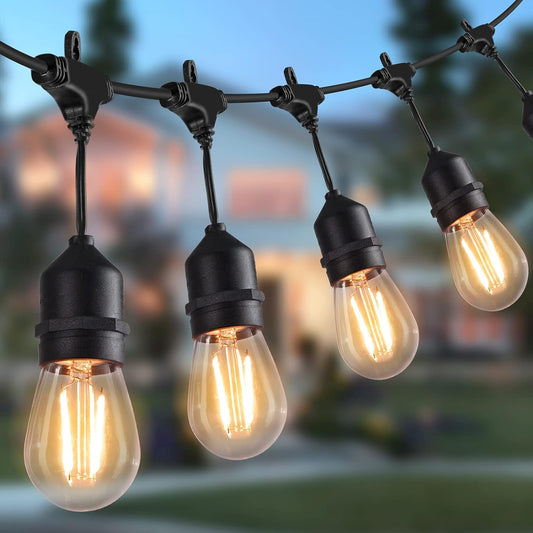
G40 / S14 festoon bulbs are heavier than micro fairy wire. Heavier = more mid-span droop for the same hang method. If you love large globes, guide wire is not optional on long spans. Shatterproof PC bulbs reduce breakage when wind bangs a low loop into a chair—but they do not reduce weight much; support still matters.
Layout patterns that look intentional (not accidental droop)
- Perimeter rectangle around the patio for dining definition
- V or X from a central pole for parties
- Parallel lines over a long table
- Soft swag (planned curve) between two strong points—different from uncontrolled sag
Planned swag uses equal bays and even hangs. Uncontrolled sag is one deep U in the middle.
Selection criteria for the string itself
When the hang plan is solid, pick lights that cooperate:
| Spec to check | Why it matters for hanging |
|---|---|
| Connectable / linkable ends | Match bay lengths; expand later |
| Outdoor IP rating (ideally IP65) | Year-round leave-up |
| Replaceable bulbs | Maintenance without rewiring the whole run |
| Wire jacket quality | Survives UV and repeated zip-tie pressure |
| Extension / spare sockets accessories | Reach the outlet without jerry-rigging |
| Adapter max power | Prevent overload when linking |
For backyard projects in North America, commercial-style outdoor string lights plus simple accessories (ties, extensions, spare holders) usually beat ultra-cheap seasonal wire that cannot take tension or UV.
Safety notes (short, non-negotiable)
- Use GFCI-protected outdoor outlets for mains-powered strings.
- Keep joins out of standing water.
- Do not staple through conductors.
- If you are unsure about drilling into fascia or load on a railing, ask a local pro—lights are easy; structural mistakes are not.
Natural next step (product angle)
Shop connectable outdoor patio string lights (G40/S14 style) with outdoor-rated jackets and, for wet climates, IP65 sealing. Pair them with a guide-wire hang and, if your layout is near kids, pets, or damp ground, consider 24V low-voltage outdoor garden strings. Browse outdoor string and extension options on foroureyes-ledlighting.com, then size runs to your measured bays—not the other way around.
Related on ForoureyesLighting: Connectable outdoor string lights · 15m G40 garden string lights · Safe install guide · 15m 24V waterproof garden lights. Note: stainless guide wire / turnbuckles are hardware-store items—we sell the lighting strings, not catenary kits.