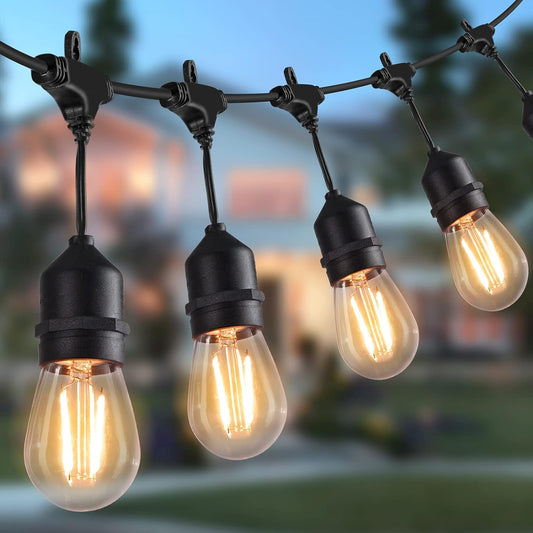
Why Patio String Lights Fill with Water: IP44 vs IP65
The scene: one rainstorm, half the string goes dark
You hung the patio lights in April. By June, after a few wet weeks, a bulb looks cloudy from the inside. Then another socket goes dead. Search forums for “string light bulb filling with water” and you will see the same story again and again: patio and backyard bistro lights that were sold as “waterproof,” then quietly failed after ordinary rain—not a hurricane, just weather.
This is not usually “bad luck.” It is often a mismatch between the IP rating on the box, how the sockets are built, and how the lights are installed outdoors year-round.
What people actually say (and the myths)
Common complaints and myths look like this:
- “They said waterproof—why is there water inside the bulb?”
- “I tightened the bulbs; still filled up.”
- “IP44 should be fine outside… right?”
- “It’s only decorative; one season is enough.” (Until you replace them every spring.)
The honest framing: “Waterproof” on a retail listing is marketing language. IP ratings are the verifiable part. Even then, IP is tested under defined conditions—it does not mean “leave it in a puddle forever with loose threads.”
IP44 vs IP65 in plain English
IP (Ingress Protection) has two digits: solids first, liquids second.
| Rating | Rough meaning outdoors | Typical OK use | Weak spot for patio strings |
|---|---|---|---|
| IP44 | Splash-resistant from any direction | Covered porch, temporary party hang, light rain under eaves | Threaded sockets can collect water; not designed as a wet-location commercial string |
| IP65 | Dust-tight + low-pressure water jets | Year-round patio, open backyard, café terrace, light hose-down | Still needs proper seating of bulbs and intact seals |
Key takeaway for permanent patio / open backyard installs: treat IP65 (or wet-location commercial strings) as the baseline, not the upgrade. IP44 is closer to “splash OK,” not “live in the rain for years.”
Tip: If a listing only says “waterproof” with no IP number, ask for the rating—or walk away.
Why water gets inside the bulb (mechanics)
Forum-style failures usually share the same paths:
1. Threads and open sockets act like funnels
Globe / G40 / S14 sockets with imperfect sealing let rain creep along the threads. Capillary action + temperature changes pull moisture inward. Once water sits on the contact, corrosion and intermittent dead sockets follow.
2. Glass bulbs crack or micro-fracture outdoors
Hail, wind slap against a beam, or thermal shock can open a path. Many homeowners then blame “the brand,” when the failure mode was fragile glass + outdoor impact.
3. End caps, joints, and mid-string connectors
A string can have a decent socket and a weak join. Water enters at the connector, then travels. Look for gasketed, lockable connectors if you plan to link multiple runs.
4. Mounting that leaves sockets cup-side up
If sockets hang so openings face the sky, they collect water. Orientation and drip loops matter as much as the rating printed on the adapter.
Selection checklist (verify before you buy)
Use this as a shopping filter—not as brand poetry:
- IP rating printed as a number — Prefer IP65 for open patios and commercial terraces.
- Replaceable bulbs — When one socket fails, you replace a bulb, not the whole 15 m run.
- Shatter-resistant PC (polycarbonate) globes — Safer than glass around decks, kids, and pets.
- Socket / gasket design — Sealing rings, proper thread depth, and weatherproof end plugs.
- Wire gauge and outdoor-rated jacket — Copper + PVC (or better) sized for outdoor UV and flex.
- Wet-location language — For North America installs, “wet location” wording plus IP65 is stronger than “outdoor use” alone.
- Voltage & adapter — Note whether the string is mains-fed or low-voltage (e.g. 24V output after an outdoor-rated adapter)—relevant for wet zones (see our companion piece on 24V).
Example of the kind of specs worth reading on a product page (illustrative of what to verify, not a substitute for the listing): IP65, warm white 2700–3000K, replaceable S14/E27 bases, PC bulbs, connectable runs (e.g. 15 m patio strings).
Install habits that keep IP65 honest
- Seat every bulb fully; do not leave half-threaded “temporary” bulbs.
- Keep connectors above splash height when possible; add drip loops before the plug.
- Do not bury joins in gutters or plant beds.
- Store or cover connectors in winter if you live where freeze–thaw is brutal—ice expands and pries seals.
- If one bulb clouds with water, dry the socket, replace the bulb, and check neighbors—moisture often travels.
Who this is for
- Homeowners hanging year-round patio / backyard string lights in North America, Australia, or Europe.
- Cafés and small venues that leave festoon lights up through rainy seasons.
- Anyone who already lived through one season of “decorative” lights and wants the next set to last.
Natural next step (product angle)
If you are shopping for open-air patio or commercial terrace strings, prioritize IP65 outdoor string lights with replaceable shatterproof PC bulbs—the same direction as commercial waterproof patio runs and 24V low-voltage outdoor garden strings on Foroureyes (foroureyes-ledlighting.com). Match length and connectability to your span; do not stretch a short decorative set across a large yard and expect seals to forgive overload or sagging stress.
Shop & guides on ForoureyesLighting: RTS classic outdoor string lights · 10m IP65 waterproof outdoor Christmas lights · IP ratings intro · Classic outdoor string lights landing · Shatterproof bulbs guide