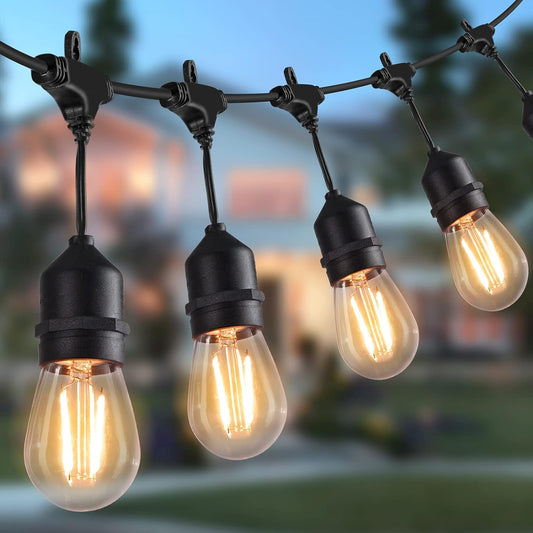
Why More People Choose 24V Outdoor String Lights
The scene: wet grass, bare feet, and a mains cable overhead
Pool decks, Gulf villa courtyards, family patios with toddlers, and café terraces washed down at night all share one quiet worry: mains-voltage decorative lighting hanging where water and people meet. You do not need to be an electrician to feel that gap. Across Middle East hospitality supply and European outdoor projects, 24V festoon / low-voltage outdoor strings keep showing up as the calmer option—not because 230V/120V strings are “illegal,” but because extra-low voltage reduces shock severity risk when something goes wrong outdoors.
What people say and assume
Typical questions:
- “Aren’t all outdoor lights already safe if they’re ‘waterproof’?”
- “24V will be too dim.”
- “Low voltage means cheap fairy wire.”
- “I’ll just use an indoor extension cord outside.” (Please don’t.)
Clarify the terms:
- IP rating = water/dust ingress into the product.
- Voltage class = how much electrical potential is present on the string after the adapter.
You want both: a proper outdoor IP (ideally IP65) and a voltage strategy that matches the site.
What “24V outdoor string lights” usually means
A common architecture:
- Mains input (AC 110V or 220–240V depending on region) into an outdoor-rated adapter / driver
- DC 24V output feeding the festoon / G40 / S14 string
- LED bulbs on the low-voltage side
Example parameter pattern you may see on product pages: input AC110/220V → output DC24V, adapter max power (e.g. 60W), string length (e.g. 15 m), IP65, warm white, replaceable bulbs. Always read the actual listing for your SKU.
Why 24V is gaining patio mindshare
1) Wet-location peace of mind
Lower voltage systems are widely preferred where strings run near irrigation, pool surrounds, frequent hose-downs, or monsoon spray. IP65 keeps water out of sockets; 24V reduces the hazard class of the conductors people can touch if a jacket is damaged.
2) Families, pets, and public seating
Kids grab cords. Pets chew. Diners lean on posts. Commercial terraces see abuse that living-room lamps never get. Low-voltage outdoor lighting is a practical risk reducer—especially when combined with good mechanical hanging (guide wire) so cords are not trip hazards.
3) Heat-heavy markets (Gulf & similar)
In hot regions, outdoor décor often stays up for months (including Ramadan storefront seasons). Specifiers look for weatherable jackets + sealed sockets + sensible voltage. Local festoon catalogs frequently highlight 24V DC options for outdoor runs; that supply pattern reflects demand for safer courtyard installs.
4) Connectable layouts without “one giant mains whip”
Many 24V patio sets are designed to link within the adapter’s watt budget. That supports modular backyard grids—provided you respect max load (bulbs × watts ≤ adapter rating, with headroom).
Myths to drop
“24V is always safer no matter the install.”
Poor adapters, indoor power supplies left in the rain, or damaged cords still fail. Put the adapter in a dry, ventilated, manufacturer-allowed location. Use GFCI/RCD protection on the mains side as local code requires.
“Low voltage cannot look premium.”
Modern LED festoon at 24V can deliver warm, hospitality-grade ambience. Check lumens per bulb, CCT (2700–3000K for dining), and CRI—not just volts.
“Any 24V bulb works on any 24V string.”
Match base type (e.g. S14/E27), polarity expectations for DC LEDs, and wattage. Replaceable-bulb systems help, but use compatible LED replacements.
Selection checklist
| Check | What “good” looks like |
|---|---|
| Output voltage | Stated DC 24V (not vague “low voltage”) |
| Adapter rating | Max watts / how many bulbs or meters supported |
| IP on the lighted string | Prefer IP65 for open wet locations |
| Bulbs | Replaceable; shatterproof PC preferred outdoors |
| Plug variants | US / EU / UK / AU as needed for your market |
| Cable | Outdoor jacket; adequate cross-section (e.g. 2×0.75 mm² class on longer runs) |
| CCT | 2700–3000K for residential/hospitality ambience |
When mains outdoor strings still make sense
- Fully covered porches with excellent drainage
- Temporary events with pro electrical supervision
- Very long commercial façades engineered as a system
Even then, many venues still choose low-voltage festoon for guest areas. It is a design choice, not a fashion trend.
Install tips specific to 24V
- Keep the adapter accessible for reset and replacement—do not bury it in mulch.
- Avoid extreme voltage drop: overly long thin extensions on the 24V side can dim end bulbs or cause flicker—use manufacturer extensions / proper wire gauge.
- Do not daisy-chain past the stated maximum.
- For pool zones and permanent wet locations, follow local electrical rules; this article is consumer guidance, not a code substitute.
Natural next step (product angle)
If your patio, garden path, or café terrace sits in a wet or family-heavy zone, look at 24V IP65 outdoor garden / patio string lights with replaceable warm-white bulbs and clear adapter watt limits—such as the 15 m 24V waterproof garden string and related 24V G40 low-voltage outdoor options on foroureyes-ledlighting.com. Pair safety voltage with proper hanging so the system stays neat and serviceable.
24V options (RTS, real prices): 15m 24V waterproof garden lights (IP65) · 24V 5m outdoor decoration lights · Low-voltage lighting advantages · Outdoor string lights collection