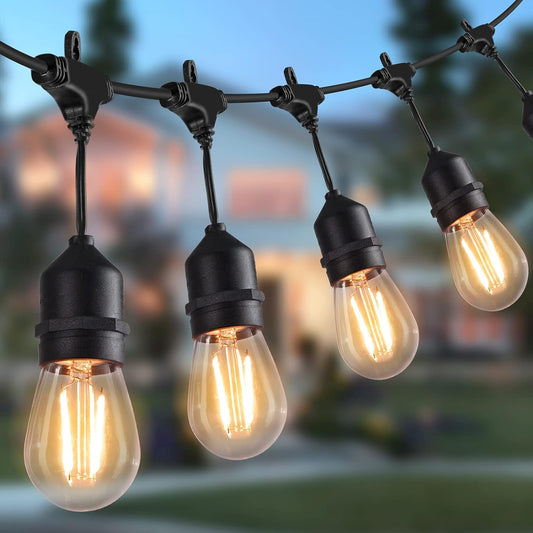
Why Outdoor String Lights Fill with Water in Two Weeks
The scene: new lights, two wet weeks, dead sockets
You ordered “outdoor” LED bulb string lights for a patio, balcony, or backyard café look. Installation took an afternoon. Then the first real rain—or even heavy dew—arrived. Two weeks later, several globes look cloudy from the inside. A few sockets will not turn off. Others are dead. The whole run starts to feel like scrap.
That timeline shows up often in US and European consumer discussions: lights owned for about two weeks, multiple bulbs full of water, some completely dead, and the blunt verdict that “outdoor” labeling did not match reality. The pattern is not exotic weather. It is ordinary moisture finding a path the listing never warned you about.
This article is a buying and install filter: what “outdoor” must mean in specs, where water actually enters on S14/G40 patio strings, and which hardware features reduce the chance you replace an entire string after one season. For a plain-English IP44 vs IP65 comparison table, see our companion guide Why Patio String Lights Fill with Water: IP44 vs IP65.
Common myths that keep selling weak strings
Myth 1: “Outdoor” on the title equals wet-location durability
Retail copy loves short words. “Outdoor,” “weatherproof,” and “waterproof” are not the same as a printed IP rating plus intact seals. If the page never shows an IP number, treat the claim as unverified marketing.
Myth 2: Tightening the bulbs is enough
Fully seating bulbs helps. It does not fix a missing gasket, a shallow thread, a cracked globe, or a mid-string connector with no seal. Capillary action and temperature swings still pull moisture along threads into the socket.
Myth 3: One dead bulb means “just replace that bulb” forever
On strings with water already inside, corrosion spreads. Moisture that enters at a joint can travel. Many owners end up discarding the entire run because sockets fail in clusters—not because LEDs “aged out.”
Myth 4: IP44 is fine for open-sky year-round patio use
IP44 is splash-oriented. For open backyard and terrace strings left up through rainy seasons in the US and Europe, IP65 (dust-tight + low-pressure water jets under the test definition) is a more honest baseline. Even IP65 fails if bulbs are half-threaded or connectors sit in a puddle.
Where water really gets in (four paths)
1. Inside the bulb / capsule
Water visible inside a globe or LED housing usually means a seal path failed: thread gap, cracked glass, micro-fracture from impact, or a plastic joint that never closed. Once liquid sits on contacts, you get intermittents, stuck-on behavior, and dead sockets.
2. At the lamp holder
S14 and G40-style sockets with weak rings or short threads act like funnels when openings face the sky. Orientation matters as much as the number on the box.
3. At mid-string and end connectors
A string can have decent sockets and a weak join. Water enters at the coupler, then follows the cable. If you plan to link multiple runs, look for gasketed, lockable, outdoor-rated connectors—not bare screw terminals under electrical tape.
4. At the plug / adapter zone
No drip loop, connector buried in a planter, or adapter left in standing water turns a “splash OK” product into a short-lived one. IP on the string does not forgive a wet primary connection.
Selection criteria you can verify on the product page
Use this checklist before holiday carts or spring patio orders. Prefer numbers and materials over adjectives.
- Printed IP rating — Prefer IP65 (or clearly labeled wet-location commercial patio / festoon strings) for open-air, year-round installs. Walk away from “waterproof” with no IP digits. IP is lab-defined; it is not a promise that loose installs survive forever.
- Replaceable bulbs (S14 / G40 / E27-style bases) — When one socket fails, swap a bulb—do not bin 10–15 m of cable. Fixed non-replaceable designs turn a single leak into a full-string loss.
- Shatter-resistant (PC / polycarbonate) globes — Glass looks premium until hail, wind slap, or thermal shock opens a crack. PC bulbs are the practical choice around decks, kids, pets, and café seating.
- Sealed sockets and connectors — Sealing rings at the bulb–socket interface, weatherproof end plugs, lockable waterproof mid-connectors if the run is connectable, and an outdoor-rated jacket with copper conductors sized for outdoor flex. Waterproof T-connectors matter when you branch a layout; a good string with a cheap unsealed split is still a leak path.
- Voltage and wet-zone practicality — Note mains-fed vs low-voltage (e.g. 24V after an outdoor-rated adapter). Voltage belongs on the same shopping card as IP and seals—especially for long garden runs. See also Why More People Choose 24V Outdoor String Lights.
- Install language, not only lifestyle photos — Prefer listings that mention wet-location use, gasket design, and replaceable shatterproof bulbs in the spec block.
Illustrative spec set worth verifying on a real SKU (not a substitute for the live page): IP65, warm white around 2700–3000K, replaceable S14/G40 bases, PC shatter-resistant bulbs, connectable patio lengths (e.g. 10–15 m class), sealed connectors.
Install habits that keep a good IP rating honest
- Seat every bulb fully; no half-threaded “temporary” globes.
- Prefer socket orientation that does not cup rain; add drip loops before plugs.
- Keep mid-connectors above splash height; do not bury joins in gutters or soil.
- In freeze–thaw climates, ice expands and pries seals—inspect connectors after winter.
- If one bulb clouds with water: power off, dry the socket, replace that bulb, and check neighbors—moisture often travels.
- Do not hose-blast seals as a “test.” Low-pressure jet ratings are not an invitation to pressure-wash electronics.
Who this is for
- Homeowners in the US and Europe hanging year-round patio, balcony, or backyard strings.
- Small cafés and terraces that leave festoon lights up through wet seasons.
- Anyone who already lived through a two-week or one-season failure and refuses to buy on the word “outdoor” alone.
Natural next step (product angle)
If your last “outdoor” string filled with water, shop the next set as hardware, not décor: IP65 outdoor S14/G40 string lights, replaceable shatterproof PC bulbs, and sealed connectors. Match length and connectability to your span; verify IP, bulb material, and connector type on the SKU page before you hang anything under open sky.
Shop & guides on ForoureyesLighting: RTS classic outdoor string lights · 15m waterproof S14 LED outdoor lights · 10m IP65 waterproof outdoor Christmas lights · 15m IP65 patio string lights · 15m G40 garden string lights · IP ratings intro · Shatterproof bulbs guide · IP44 vs IP65 companion article